Last modified: 2014-10-08
Abstract
Lithium iron phosphate (LiFePO4) is a very hopeful positive electrode material of lithium-ion power battery, because of its abundance of raw materials, low cost, stable structure, excellent cycling performance and high theoretical capacity. However, pristine LiFePO4 has two main disadvantages of slow lithium-ion diffusion and low electronic conductivity, which lead to poor rate capability and limit its wide applications. To overcome these disadvantages, in this work, we synthesized the composites of LiFePO4 and nanocarbon (carbon nanotube, nitrogen-doped carbon nanotube, etc.), and investigated the effects of the various additives on their morphology, microstructure and electrochemical performance. The structure and morphology of the composites were investigated by X-ray diffraction (XRD) and scanning electron microscope (SEM, typical images as shown in Fig.1a and b). The electrochemical performance of the composites was evaluated by charge-discharge test, cyclic voltammetry and impedance spectroscopy. The LiFePO4 and nitrogen doped carbon nanotube composite materials presented more uniform dispersion, stronger interaction, greatly improved lithium storage capacity, rate capability and cycling stability, which are promising for high performance lithium-ion power battery applications.
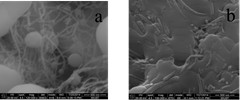
Fig.1 SEM images of LiFePO4-CNT (a) and LiFePO4-NCNT (b). Acknowledgements: This work was supported by the National Natural Science Foundation of China (No. 51372178) and the Natural Science Foundation for Distinguished Young Scholars of Hubei Province of China (No. 2013CFA021).