Last modified: 2014-09-29
Abstract
According to the capillary transport theory in porous materials, the rate of liquid transport can be effectively controlled by the spatial wettabilityvariation of porous electrode [1-4]. Therefore, in the research field of direct methanol fuel cell (DMFCs), many researchers have focused on multi-layered electrode designs, using additional hydrophobic layers [5-8] and/or PTFE-treated anode backing layers (BLs) [9-11], which successfully reduced methanol crossover and/or water flooding inside a DMFC. In this study, we propose new catalyst layer (CL) designs based on double-layered structure; one is coated on the backing layer side whereas the other is on the membrane side. These two CLs are designed to exhibit different wetting characteristics. The hydrophilic CL can be fabricated with conventional Nafion binder whereas both Nafion and PTFE binders are used to design relatively hydrophobic CL. Combining two layers for the anode or cathode CL enables to effectively control methanol transport in the anode side, water transport in the cathode, water and methanol crossover through the membrane. To examine its influence, four different membrane electrode assemblies (MEAs) with different combinations of anode and cathode CLs are fabricated and tested under different methanol feed concentrations. Fig. 1 schematically depicts the four MEA designs, namely MEA-1, MEA-2, MEA-3, and MEA-4.
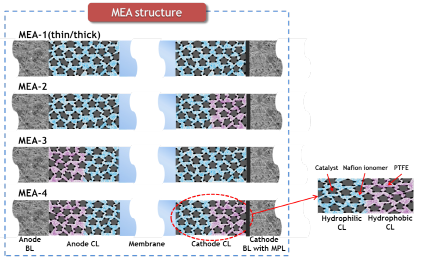
Figure1. The schematic diagram of four MEA designs with different anode and cathode CLs.
A comparison of polarization curves in Fig. 2 clearly demonstrates a substantial influence of double-layered CL structure on methanol and water transport, and resultant overall cell performance. In addition to the experimental observation, a one-dimensional hybrid CL model is newly developed and simulated in order to theoretically analyze methanol and water transport characteristics through the double-layered (hydrophobic + hydrophilic) CL structures. This study emphasizes that controlling wetting characteristics of CLs is effective to obtain favorable methanol and water profiles inside a DMFC.
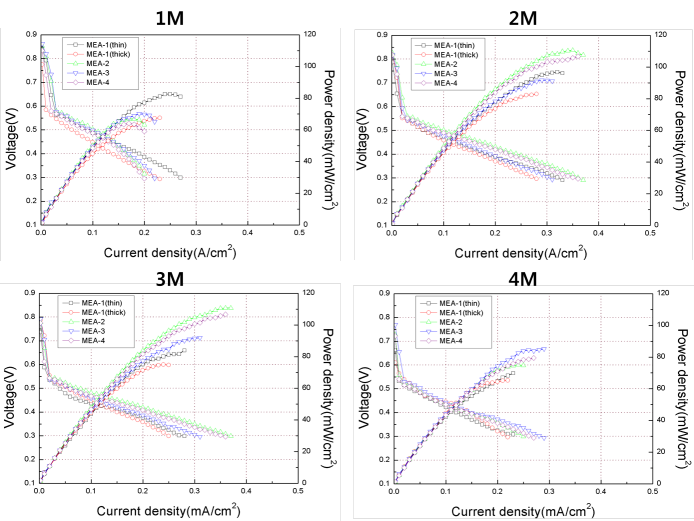
Figure2. Polarization curves of MEAs measured at different methanol-feed concentrations (2M, 4M). The cell was operated at 60℃ and an anode/cathode stoichiometry of 3/3 at 200mA/cm².
presentor : Kise Lee
Keywords
References
[1] H.C. Ju, J. Power Sources. 185 (2008) 55
[2] K.M. Kang, K.M. Oh, S.H. Park, A.R. Jo, H.C. Ju, J. Power Sources. 212 (2012) 93
[3] A. Pablo, G. Salaberri, M. Vera, I. Iglesias, J. Power Sources. 246 (2014) 239
[4] C.E. Shaffer, C.Y. Wang, Electrochimica Acta. 54 (2009) 5761
[5] K.M. Kang, G.Y. Lee, G.H. Gwak, Y.J. Choi, H.C. Ju, Int. J. Hydrogen Energy. 37 (2012) 6285
[6] Y.C. Park, D.H. Kim, S.Y. Lim, S.K. Kim, D.H. Peck, D.H. Jung, Int. J. Hydrogen Energy. 37 (2012) 4717
[7] C.G. Suo, X.W. Liu, X.C. Tang, Y.F. Zhang, B. Zhang, P. Zhang, Electrochemistry commun. 10 (2008) 1606
[8] J.Y. Cao, M. Chen, J. Chen, S.J. Wang, Z.Q. Zou, Z.L. Lin, D. L. Akins, H. Yang, Int. J. Hydrogen Energy. 35 (2010) 4622
[9] C. Xu, T.S. Zhao, Q. Ye, Electrochim. Acta. 51 (2006) 5524
[10] K.M. Kang, S.H. Park, G.H. Gwak, A.R. Jo, M.S. Kim, Y.D. Lim, W.H. Kim, T.W. Hong, D.M. Kim, H.C. Ju, Int. J. Hydrogen Energy. 39 (2014) 1564
[11] C.M. Hwang, M. Ishida, H. Ito, T. Maeda, A. Nakano, A. Kato, T. Yoshida, J. Int. Cou. Electrical Engineering. 2 (2012) 171