Last modified: 2014-10-08
Abstract
1. INTRODUCTION
The conversion of CO2 to fuels and chemical feedstock is an attractive proposition which may provide
an alternative solution to both the current energy crisis and climate issues[1]. Among many routes,
electrochemical reduction of CO2 is a promising process because the product can be selectively controlled
by changing the electrolysis condition, such as electrode and electrolyte[2]. A key technological challenge
for electrochemical reduction of CO2 is the preparation of the electrode with high catalytic activity, high
selectivity and long term stability. Metal complexes with bipyridine ligands has evoked great interest to
researchers since these kinds of catalysts showed high catalytic stability, producing CO and hydrocarbons
in high yield. Also, it was reported that CoPc and NiPc complexes coated on a graphite electrode showed
some catalytic activity for CO2 electroreduction, with HCOOH being the predominant product in aqueous
solutions (pH 3-7)[3]. In the exploration of new catalysts, gas diffusion electrode (GDE) modified with
N-N' bis(salicylidene)-ethylenediamino-cobalt(II) (CoSalen) and conductive carbon black BP-2000 was found
to be an effective catalyst for CO2 reduction, where both the type of the metal and the structure of the ligands
play important roles in the catalytic behavior of these complexes. On the basis of these observations, we
here report a systematic study on the effects of the electrolyte in terms of the nature of the cations, the
anions, and concentration to better understand the mechanisms of the effects of the electrolyte on the
electrochemical reduction of CO2.
2. MethodsMaterials synthesis
The CoSalen-BP was synthesized by grinding the mixture of catalyst and BP. In this work, different
proportion (20%, 40%, 60%, 80%) of CoSalen and BP are mixed together, gradually adding 10ml of
methanol into the mixture and keep grinding until dry mill. After that, it was dried in a vacuum oven
at 60oC for an hour for obtaining the final catalyst samples.
Electrode preparation and electrochemical measurements
In the electrode fabrications, 10 mg of CoSalen-BP particles were dispersed in the mixture of
150 mg of 5 wt.% Nafion solution and 200mL of 99.7 wt.% isopropyl alcohol to make a catalyst ink,
then the ink was coated in the gas diffusion carbon paper sheets (TGP-H-090) (4 cm-2) to form the
working electrode. Electrochemical reduction of CO2 was carried out in a three-electrode H-type cell
where a platinum wire (8 cm2) and saturated calomel electrode (SCE) were used as the
counter and reference electrodes, respectively, and a piece of Nafion® 117 cation exchange membrane
(H+ form) was used as a separator. Electrochemical characterizations were conducted by a Electrochemical
analyzer (CHI600E 413183) in cyclic voltammetry (CV).
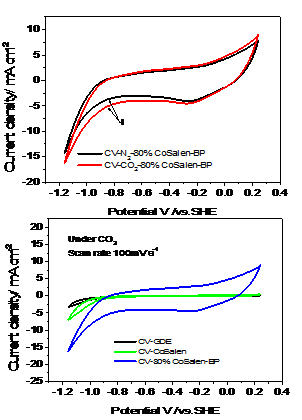
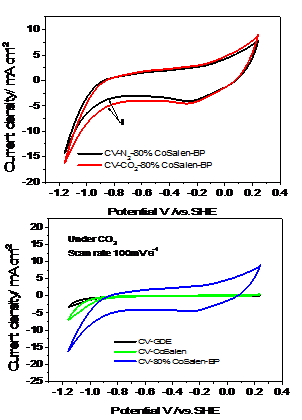
3. ResultsFig. 1(a) shows the CV curves of 80%CoSalen-BP in both N2 and CO2-saturated 0.5 M KHCO3 solution.
Compared with the CV curve in an N2 atmosphere, for CO2-saturated 0.5 M KHCO3 solution, an obvious
positive shift in peak I is observed, suggesting that CO2 can be catalytically electroreduced by
80%CoSalen-BP[4]. Fig. 1(b) shows the CV curves for CoSalen and CoSalen-BP-modified and
non-modified GDE in CO2-saturated 0.5M KHCO3 solution. It can be seen that the CoSalen-BP
coated at GDE exhibited the least negative cathode over potential at -0.8 V vs. SHE, a more
positive potential than CoSalen coated GDE and bare GDE. In addition, for CoSalen-BP coated
GDE, a significant increase in current density was also observed, which is attributed
to more positive catalytic reduction of CO2. Since BP has very high specific surface area up to 2000 m2 g-1, and developed pore structure with very good electrical conductivity, it’s suitable to use it as catalyst to
improve electrode performance. In our study, the electrolytes on CO2 reduction are also examined
extensively including KHCO3, K2SO4, KCl, Na2SO4, Na2CO3 and NaHCO3. Among all electrolytes,
0.5M K2SO4 was observed to has most positive potential compared to other electrolytes, whereas
the highest total reduction current density up to 20 mA cm-2 was observed in 0.5M KHCO3. This may be
mainly attributed to the equilibrium between HCO3−and CO2, thus providing sufficient local dissolved
CO2 to the interface between the GDE electrode and the electrolyte for the reaction.
Acknowledgements
This work was financially supported by the National Natural Science Foundation of China (21173039);
the Specialized Research Fund for the Doctoral Program of Higher Education, SRFD (20110075110001) of China;
the Innovation Program of the Shanghai Municipal Education Commission (14ZZ074); the International Academic
Cooperation and Exchange Program of Shanghai Science and Technology Committee (14520721900) and the College
of Environmental Science and Engineering, State Environmental Protection Engineering Center for Pollution Treatment
and Control in Textile Industry, Donghua University. All the financial supports are gratefully acknowledged.
References[1] L. Qiao, Y. Y. Liu, Y.Y, F. Hong, J. J. Zhang, “A review of catalysts for the electroreduction of carbon dioxide to produce low-carbon fuels”, Chem. Soc. Rev., Vol. 43, pp. 631-675, 2014.
[2] W. X. Lv, R. Zhang, P. G. Gao, L. X. Lei, Studies on the faradaic efficiency for electrochemical reduction of carbon dioxide to formate on tin electrode, J. Power Sources., pp.276-281, 2014.
[3]S. Kapusta and N. Hackerman, Catalyzed Carbon Electrode Carbon Dioxide Reduction at a Metal Phthalocyanine, J. Electrochem. Soc. , Vol.131, pp.1511-1514, 1984.
[4] H.-Z. Zhao, Y-Y. Chang, C. Liu, Electrodes modified with iron porphyrin and carbon nanotubes: application to CO2 reduction and mechanism of synergistic electrocatalysis, J. Solid State Electrochem, pp.1657–1664, 2013.
Yishu Fu is a second year master-course student in the Department of Environmental Science and Engineering of Donghua University, China.
She graduated from Shanghai Institute of Technology in 2013, and has been given the honorary title of outstanding graduates
of Shanghai. After that, she joined in Prof. Jinli Qiao’s reach team and engaged in R&D of advanced nanocatalysts for electrochemical
reduction of CO2. Now she is a student membership of the International Academy of Electrochemical Energy Science.