Last modified: 2014-10-08
Abstract
Electric double layer capacitors (EDLCs) have attracted widespread attention in recent years owing to their ability to supply high power in short-term pulse and long cycling durability, which make them very good energy storage devices for applications such as hybrid power sources for electrical vehicles, digital telecommunication systems and other energy fields [1-3]. Based on the electrochemical charge accommodation at the electric double layer and the occurrence of Faradic reactions, the electrochemical performance of EDLC largely depends on the electrode materials. Various materials are used in EDLCs such as carbon-based material, transition metal-oxides, and conductive polymers, in which carbon-based materials have been actively investigated for use as the electrode materials for its high specific surface, relatively low cost and non-toxicity [4] In addition, the pore size distribution of carbon materials is important to their electrochemical performances. Mesoporous carbon have a variety of properties including high specific surface area, easily accessed ordered pore channels [3]. In order to further enhance the capacitance, heteroatoms were doped to carbon materials, which not only decrease charge transfer resistance between the electrode and electrolyte but also increase wettability by modification of surface properties [5, 6]. In this paper, by applying poly(ethyleneimine) (PEI)as sources of both of N and C, ferrous sulfate as precursor of sulfur and metal, and the nanoscaled silica as sacrificial supports to create pores, we have successfully synthesized N, S-dual doped mesoporous carbon and, realized a supercapacitor with greatly enhanced property.
2. MethodsMaterials and catalyst synthesis
For the syntheisis of mesoporous carbon, Fe and PEI were dispersed onto the surface of SiO2 (the total metal loading with respect to silica is 15 wt %), then SiO2 was etched by 40 wt % HF after the product was dried at 85oC for 24h. The resultant powder was further pyrolized in an N2 atmosphere at 800oC for 1h. The vacated SiO2 particles lead to creation of pores with pore size around 100 nm. The final powder was washed to be neutral by purified water and then dried overnight.
Electrode preparation and electrochemical test
The electrodes were prepared by mixing 70 wt % mesoporous carbon, 7.5 wt % acetylene black and 22.5 wt % Nafion. The electrochemical performance of N, S-dual doped mesoporous carbon was characterized by cyclic voltammetry (CV) in 0.5 M H2SO4 solution at room temperature. The test cell was a three-electrode system in which gas diffusion layer supported mesoporous carbon was assembled as working electrode. A platinum wire and a saturated calomel electrode (SHE) were used as the counter electrode and the reference electrode, respectively
3. Results The voltammetric responses are employed to evaluate the electrochemical characteristics of electrode materials. Fig. 1 shows the CV curves of mesoporous carbon electrode in 0.5 M H2SO4 solution at a variety of sweep rates varying from 3 to 150 mV/s, in the potential range from -0.24 to 0.76 V vs SHE. It can be seen that the redox current progressively increased with increasing potential scan rate. In particular, the CV curves maintain a relatively good rectangular shape even at a sweep rate as high as150 mV/s. These results indicate their excellent capacitor behaviors, which can be attributed to increases in surface area and available pores due to the presence of mesoporous carbon. The high specific surface area of porous structure contributes to a high retention of specific capacitance for electrode at a high current density. Also, the mesopores play an important role in diffusion resistance of ions within electrodes and improving the effective surface [7].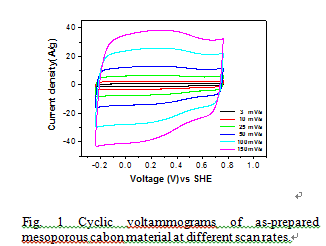
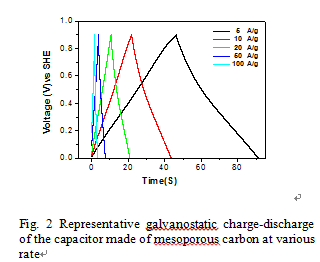
Galvanostatic charge/discharge method was also applied to evaluate the capacitance of mesoporous carbon electrode as-prepared in this work. Plots of potential versus time for the mesoporous carbon electrode at various rates are shown in Fig. 8. A symmetric charge/discharge characteristic of triangular shape which is typical for ideal capacitor behavior was clearly observed even at high current load of 100 A/g, demonstrating the fast charge propagation with a very small ohmic drop. The specific capacitance calculated from the galvanostatic charge curve is high up to 256 F/g at a current density of 5 A/g. Very promisingly, when the current density was increased to 100 A/g , the specific capacitance still remained at 236F/g with ~92% capacitance retention, which can not only be attributed to the appropriate porous size but also to the variation of the electronic structure and interactions between heteroatoms and carbon atoms. The details will be reported in the meeting, particular to the doped effect on the enhanced supercapacitor performances.
Keywords
References
[1] Conway. B. E. Electrochemical Supercapacitors: Scientific Fundamentals and Technological Applications; Kluwer Academic: pp. 11-13(chapter 2), 1999.
[2] Zhou. H, Zhu. S, Hibino. M, et al. Electrochemical capacitance of self-ordered mesoporous carbon[J]. Journal of Power Sources, Vol. 122(2), pp. 219-223, 2003.
[3] Vix-Guterl. C, Frackowiak. E, Jurewicz. K, et al. Electrochemical energy storage in ordered porous carbon materials[J]. Carbon, Vol. 43(6), pp. 1293-1302, 2005.
[4] Zhang. Y, Feng. H, Wu. X, et al. Progress of electrochemical capacitor electrode materials: A review[J]. International journal of hydrogen energy, Vol. 34(11), pp. 4889-4899, 2009.
[5] Yu. X, Park. H. S. Sulfur-incorporated, porous graphene films for high performance flexible electrochemical capacitors[J]. Carbon, Vol. 77, pp. 59-65, 2014.
[6] Guo. H, Gao. Q. Boron and nitrogen co-doped porous carbon and its enhanced properties as supercapacitor[J]. Journal of Power Sources, Vol. 186(2), pp. 551-556, 2009.
[7] Tang. L, Zhan. L, Yang. G, et al. Preparation of mesoporous carbon microsphere/activated carbon composite for electric double-layer capacitors[J]. New Carbon Materials,Vol. 26(3), pp. 237-240, 2011.