Last modified: 2014-10-08
Abstract
The alkaline membrane fuel cells (AMFCs), which use the anion-exchange membranes (AEMs) as electrolytes have attracted considerable attention owing to their higher reaction kinetics, lower fuel crossover, reduced CO poisoning, and use of non-precious metal catalysts [1]. In the development of AMFCs, the AEMs are obviously the key issues to make a breakthrough in AMFC performances. However, the conductivity and stability of AEMs are still far less than commercially available Nafion® membrane which has commonly been used to proton-exchange membrane fuel cells (PEMFCs) [2]. On the other hand, as a hydrophilic, inexpensive, biodegradable, non-toxic and low cost natural material, chitosan has recently been reported to show good chemical and physical stability [3-4]. Based on this conception, we here report the novel series of alkaline anion-exchange membranes: Chitosan/EMImC-Co-EP (1-Ethenyl-3-methyl-1H-imidazoliumchloride polymer with 1-ethenyl-2-pyrrolidone) membranes and, their synthesis and properties are investigated in detail.
2. MethodsMaterials and membrane preparation
The membranes were prepared by a solution-casting method, where 1g chitosan (degree of deacetylation = 80.0 - 95.0, supplied by Sinopharm Chemical Reagent Co. Ltd. China) was dissolved in 50 mL of 2% aqueous solution of acetic acid and stirred until complete dissolution. EMImC-Co-EP (40% as active ingredients in H2O, average molecular weight Mw = 400,000, Aldrich) was separately prepared, then EMImC-Co-EP and chitosan were mixed in different proportions under stirring overnight to get a homogeneous appearance. The final resulting solution were poured into the plastic dishes, and dried in the ambient conditions. Membranes were obtained with a thickness about 50 ~ 100µm. To investigate the effect of the content of EMImC-Co-EP on the membrane performances, Chitosan/EMImC-Co-EP mass ratio was ranged from 1:0.25 to 1:1. Before the use, the samples were kept at 140oC for 1 h, then soaked in a reaction solution containing 10 mass% glutaraldehyde (GA: 25 wt% solution in water: SCRC) in acetone for chemical cross-linking with a small amount of hydrochloric acid as catalyst for 1 h. The membranes were rendered conducting by immersion of Chitosan/EMImC-Co-EP membranes into 2M KOH and equilibrated for 24h to convert it from Cl- into OH- form. A model of the inner structure of Chitosan/EMImC-Co-EP membranes was given in Fig.1.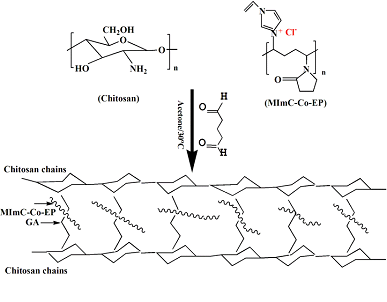
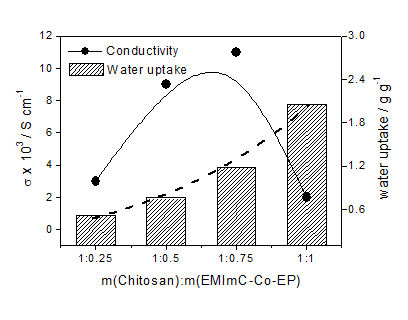
Fig. 2 shows the OH- conduction and water uptake (WU) of Chitosan/EMImC-Co-EP membranes as a function of EMImC-Co-EP content, where the Chitosan/EMImC-Co-EP mass ratio was ranged from 1:0.25 to 1:1. It is found that the OH- conductivity and WU of the membranes increases with EMImC-Co-EP content, then reaches a plateau at a Chitosan/EMImC-Co-EP mass ratio of 1:0.75. At this stage the OH- conductivity of high up to 0.011S cm-1 is achieved.
The increased OH- conductivity can be attributed to the increased number of charge carriers (EMImC-Co-EP). However, further addition of EMImC-Co-EP to the polymer leads to a sharp decrease in OH- conductivity, where the OH- conductivity of the Chitosan/EMImC-Co-EP mass ratio as 1:1 is only 0.002S cm-1. This is probably due to the high water uptake of the membrane with additional content of EMImC-Co-EP. Since Chitosan and EMImC-Co-EP are both highly hydrophilic property, the large sorption of water at Chitosan/EMImC-Co-EP membrane (1:1 by mass) does not only give improved ionic conductivity but also a dilution of charge carriers [5]. Some membranes in this work exhibited promising characteristics and have the potential for applications in alkaline polymer electrolyte fuel cells in considering their integrative properties.
References
[1] Y. J. Wang, J. L. Qiao, R. Baker, J. J. Zhang, “Alkaline polymer electrolyte membranes for fuel cell applications,” Chem. Soc. Rev., Vol. 42, pp.5768-5787, 2013.
[2] J. L. Qiao, J. Fu, R. Lin, J. X. Ma, J. S. Liu, “Alkaline solid polymer electrolyte membranes based on structurally modified PVA/PVP with improved alkali stability,” Polymer, Vol. 51, pp. 4850-4859, 2010.
[3] J. Ma, Choudhury N A, Sahai Y, et al. “A high performance direct borohydride fuel cell employing cross-linked chitosan membrane,”. J. Power Sources., Vol.20, pp.8257-8264, 2011.
[4] Y.J. Liu, X.H. Cao, R. Hua, Y.Q. Wang, “Selective adsorption of uranyl ion on ion-imprinted chitosan/PVA cross-linked hydrogel,” Hydrometallurgy, Vol. 104, pp. 150-155, 2010.
[5] J.L. Qiao, T. Hamaya, T. Okada, “New highly proton-conducting membrane poly(vinylpyrrolidone)(PVP) modified poly(vinyl alcohol)/2-acrylamido-2-methyl-1-propanesulfonic acid (PVA–PAMPS) for low temperature direct methanol fuel cells (DMFCs),” Polymer, Vol. 46, pp. 10809-10816, 2005.