Last modified: 2014-10-15
Abstract
As a promising candidate to update the commercial graphite anode in lithium ion battery, SnO2 has attracted particular interests because of its high theoretical capacity (1482 mAh g-1), which is around four times of graphite (372 mAh g-1) [1]. Unfortunately, SnO2 undergoes fast capacity fading caused by enormous volume change and suffers from poor rate performance because of the low electronic conductivity, which hinders its practical application [2]. Herein, we demonstrate high electrochemical Li-storage performance in SnO2/Ni nanocomposite electrode for the first time with SnO2 and Ni distributed uniformly across the whole electrode. There are two distinguished features of such SnO2/Ni nanocomposites: 1) SnO2 can be spatially confined in the original site by the surrounding Ni nanoparticles, which maintain the structure integrity and therefore enhance the cycling stability; 2) The enhanced electron conduction by the introduction of nickel are favorable for the high rate capability of electrode.
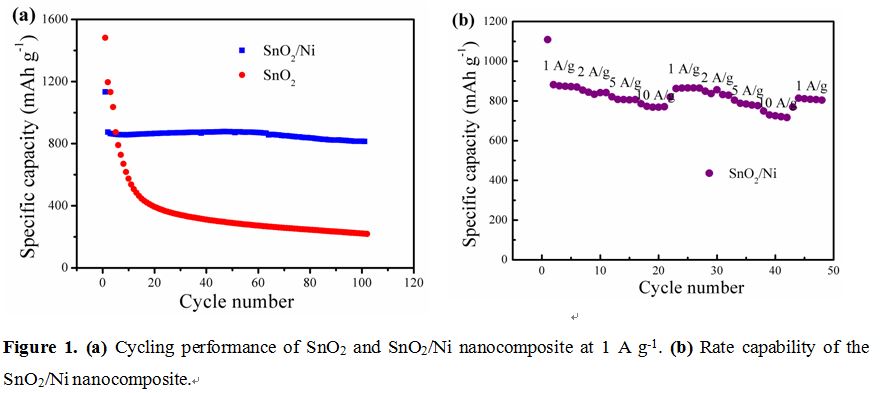
As shown in Figure 1a, the SnO2/Ni nanocomposite shows excellent cycling stability over 100 cycles even at ultra-high current density of 1 A g-1. After an initial discharge capacity of 1133.7 mAh g-1, the SnO2/Ni nanocomposite still delivers a capacity of 815.4 mAh g-1 at the end of 100 cycles, which corresponds to capacity retention of 71.9%. By contrast, the pure SnO2 exhibit very poor cycle performance with a severe capacity fading. At 100th cycle, the pure SnO2 can only maintains 218.0 mAh g-1, which is about 14.7% of the first discharge capacity. Based on our knowledge, the present SnO2/Ni nanocomposite demonstrates the best cycling stability at high current density (1 A g-1) in SnO2-based carbon free electrodes so far. Meantime, the SnO2/Ni nanocomposite also displays outstanding rate capability (Figure 1b). As the current densities increase stepwise from 1 to 2, 5, and 10 A g-1, the electrode delivers stable capacities at each of these rates, ranging from 870.0 to 841.9, 806.6 and 770.8 mA h g−1, corresponding to 96.7%, 92.7% and 88.6% of the discharge capacity at 1 A g-1, respectively.
Presenter: Yong Li
Keywords
References
[1] Zhou, X.; Wan, L.J.; Guo, Y.G. Adv. Mater., 2013, 25, 2152.
[2] Tang, Y.; Wu, D.; Chen, S.; Zhang, F.; Jia, J.; Feng, X. Energy Environ. Sci., 2013, 6, 2447