Last modified: 2014-10-08
Abstract
Anion-exchange membrane fuel cells (AEMFCs) researches have recently made a noticeable comeback from proton-exchange membrane fuel cells (PEMFCs) dominant era, since the AEMFCs can get faster electrokinetics, lower fuel crossover, reduced CO poisoning, and use of non-precious metal catalysts[1-2]. In the development of AEMFCs, alkaline anion-exchange membranes (AEMs) play a critical role in making a breakthrough in AEMFCs performances. The basic requirements of an AEM for use in AEMFCs are that it should have good mechanical and chemical stability besides the high OH- conductivity[3]. In addition, the stability of the quaternary ammonia groups has to be improved which are likely to decompose in concentrated alkali solutions, especially at elevated temperatures (above 60oC) via by either an E2 Hofmann elimination or by an SN2 substitution reaction[4-6]. In order to fulfill all the aforementioned requirements, our most recent research has focused on the introduction of novel alkaline anion-exchange membranes based on cross-linked PVA/Luviquat® FC370 [poly(vinly alcohol) and poly(3-methyl-1-vinylimidazolium chioride)-co-(1-vinylpyrrolidone)], which show excellent mechanical strength and good membrane stability.
2. MethodsMaterials and membrane synthesis
The membrane was prepared by a simple solution-casting method. A stock PVA(99% hydrolyzed, average molecular weight Mw=86,000~89,000, Aldrich) aqueous solution was prepared by dissolving PVA in deionized water to make a 10% solution at 90oC with continuous stirring until a transparent solution was obtained. Luviquat® FC370(40% as active ingredients in H2O, average molecular weight Mw=400,000, Aldrich) was separately prepared, then mixed with the above PVA solution under stirring for at least 2 h to make sure that the new solution was completely homogeneous, in which the PVA/Luviquat® FC370 was 1:1 by mass. Then the resulting solutions were poured into plastic Petri dishes, and water was evaporated under ambient conditions. When visually dry, the membrane was peeled from the plastic substrate with a thickness of about 60~100 mm. To investigate the thermal cross-linking effect on membrane performances, cross-linking processes were proceeded by changing the annealing temperature from 130 to 190 oC for 1 h, then samples were soaked in a reaction solution containing 10 mass% glutaraldehyde(GA: 25 wt% solution in water: SCRC) with a small amount of hydrochloric acid while kept the chemical cross-linking time for 1 h. Tensile evaluation was performed on a universal material testing machine (H5K-S, Hounsfield) under ambient condition (room temperature, ~50% relative humidity) at a speed of 5 mm min−1 with a 1000 N sensor loaded. The mean value was obtained from at least three strip samples with the size of 1 cm×2 cm.
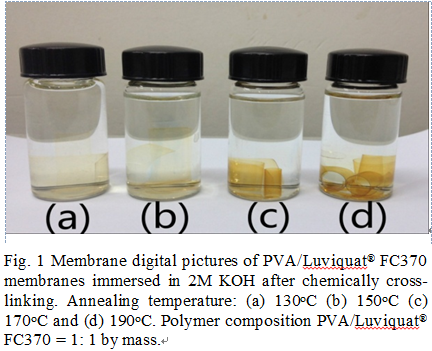
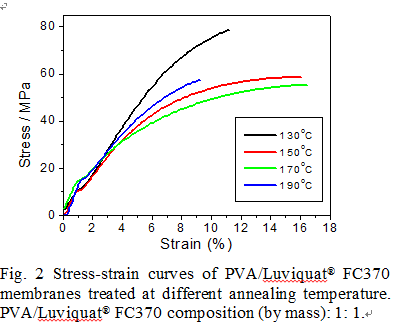
3. ResultsAs a typical candidate, Fig. 1 shows the membrane digital pictures of PVA/Luviquat® FC370 membranes immersed in 2M KOH after chemically cross-linking, while annealing temperature ranges from 130oC to 190oC. All the anion-exchange membranes PVA/Luviquat® FC370 are transparent with light yellow, flexible, and can be easily cut into any size. Fig. 2 shows stress-strain curves of PVA/Luviquat® FC370 membranes treated at different annealing temperatures. The tensile stress at break of PVA/Luviquat® FC370 membranes is in a range of 59.3~76.6 MPa, the elongation at break is around 9.2~14.9% and the Yong’s modulusis about 791.7~958.5 MPa, respectively.
It can be clearly seen that tensile elongation of the membranes increased with an increase in annealing temperature, whereas the tensile strength decreased, and the values of membrane treated at annealing temperature 190oC within the limit of error. PVA/Luviquat® FC370 membranes treated at 170oC displayed the highest mechanical property: the tensile elongation of 10.6% enrolled a tensile strength of 50 MPa, while still tolerated high tensile strength when compared to those tested samples under other annealing conditions. The excellent mechanical property is generally of concern due to known degradation mechanisms: b-hydrogen elimination and direct nucleophilic substitution at a-carbon. The excellent mechanical performance of PVA/Luviquat® FC370 membranes developed in this work may afford it a unique position and are very promising for practical applications in fuel cell technology and other electrochemical devices.
References
[1] Y. J. Wang, J. L. Qiao, R. Baker, J. J. Zhang, “Alkaline polymer electrolyte membranes for fuelcell applications,”Chem. Soc. Rev., Vol. 42, pp.5768-5787, 2013.
[2] J. L. Qiao, J. Fu, R. Lin, J. X. Ma, J. S. Liu, “Alkaline solid polymer electrolyte membranes based on structurally modifiedPVA/PVP with improved alkali stability,”Polymer, Vol. 51, pp. 4850-4859, 2010.
[3] J. Zhang, Y. Gao, T. C. Zhou, J. L. Qiao, “Synthesis and Conductivity of Multiwalled Carbon Nanotubes ModifiedPoly(vinyl alcohol)/Poly(diallyldimethylammonium chloride)as Alkaline Anion-Exchange Membranes, Electrochem. Soc. , Vol. 58,pp. 425-430, 2013.
[4] J. Zhang, J. L. Qiao, G. P. Jiang, L. L. Liu, Y. Y. Liu,“Cross-linked poly(vinyl alcohol)/poly (diallyldimethylammonium chloride) as anion-exchange membrane for fuel cell applications,” J. Power Sources, Vol. 240, pp. 359-367, 2013.
[5] J. L. Qiao, J. Fu, L. L. Liu, J. Zhang, J. Xie, G. Li, “Synthesis and properties of chemically cross-linked poly(vinyl alcohol)-poly(acrylamide-co-diallyldimethylammonium chloride) (PVA-PAADDA) foranion-exchange membranes,” Solid State Ionics, Vol. 214, pp. 6-12, 2012.
[6] J. Fu, J. L. Qiao, X. Z. Wang, J. X. Ma, T. Okada, “Alkali doped poly(vinyl alcohol) for potential fuel cell applications,” Synthetic Met. Vol. 160, pp. 193-199, 2010.